

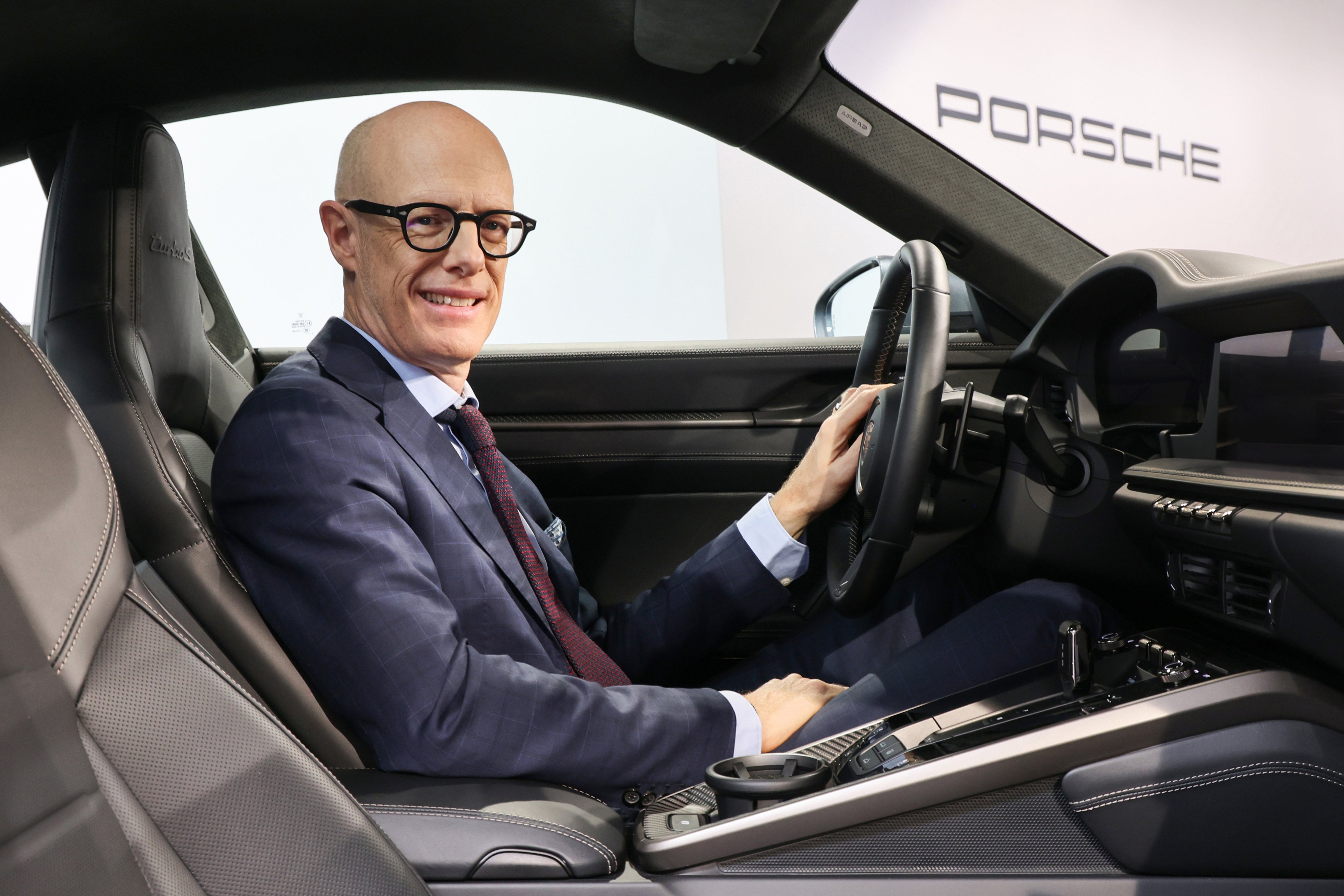
Well, why do people want to buy a Porsche?
The answer lies at the center of Sportwagenschmiede ’35, a strategy Porsche unveiled this week. On paper, it is a corporate turnaround plan filled with targets for margins, headcount and development costs. But to really sum it all up, porsche wants to become smaller, more expensive, and more unmistakably Porsche.

Leiters is also an interesting candidate to attempt this reset. He took over from Oliver Blume at the beginning of 2026 after previously serving as CEO of McLaren and chief technology officer at Ferrari. Before either, he spent more than 13 years at Porsche, eventually overseeing its SUV programs. In other words, his resume touches almost every contradiction Porsche now has to reconcile. That list of contradictions includes exclusivity and scale, sports cars and SUVs, electrification and combustion, engineering purity and profitability.
But profitability is very much part of their problem.
Porsche’s operating margin fell to just a mere 1.1 percent in 2025, a remarkable comedown for a company that spent years being one of the automotive industry’s great profit machines. So to be clear, this response is not Porsche just trying to claw back at its old sales numbers.
However that may prove to be the most consequential part of Leiters’ grand Porsche vision. For years, the company became exceptionally good at stretching its identity across an increasingly broad catalog. It contained SUVs, sedans, crossovers, EVs, and a wild number of derivatives within each model line. This previous expansion strategy did make Porsche larger, but it never really made the brand or product feel any more special. Yet this isn’t the retreat to a tiny sports-car manufacturer that enthusiasts occasionally fantasize about. Porsche will still build four-doors, SUVs and electric cars.

The EV-only trajectory has given way to what Porsche calls a three-pronged approach: battery-electric cars, plug-in hybrids and combustion engines will coexist. The electric 718 is still coming (which has more implications I will discuss in a later article), and Porsche continues to invest in battery technology, but combustion development isn’t being treated as yesterday’s business. Most symbolically, Leiters has confirmed that there are no plans for an electric 911.
That doesn’t make the new Porsche anti-EV. It makes it anti-dogma. If an electric drivetrain can create the right car, Porsche will use one. If a hybrid makes more sense, it will use that. If a combustion engine remains fundamental to a model’s character, Porsche is apparently prepared to defend it. The powertrain becomes a means to Porsche as opposed to necesarily being the brand strategy itself.
For enthusiasts there are even more interesting things down the line.
Porsche is developing the architecture for a mid-engined super sports car positioned above the 911, while at the same time promising other 911 focused derivatives. They’re also looking into another SUV above the Cayenne, proof that the accountants have not suddenly been expelled from Zuffenhausen. A broader commitment is to introduce at least one “brand-defining” new product every year through 2030.
Perhaps the clearest expression of Porsche’s new direction is not a future model. It’s Manthey, Sonderwunsch, & Exclusive Manufaktur.
Porsche has announced an increased stake in Manthey Racing, which now sits at 67 percent. The move effectively pulls the Nürburgring-based performance specialist into the company’s core product strategy. Manthey will be apart of Porsche’s new “Home of Sports Cars” structure alongside Exclusive Manufaktur, Sonderwunsch, and the company’s heritage operations. Porsche says the relationship will expand beyond the familiar Manthey performance kits into exclusive track experiences and even complete, ultra-limited vehicle concepts.

Manthey represents something Porsche cannot manufacture through branding alone, which is their legendary reputation earned racing at circuits. The company has decades of GT racing experience, seven overall Nürburgring 24 Hours victories, and an existing reputation among Porsche owners.
Additionally, Sonderwunsch, Exclusive Manufaktur, and Porsche’s heritage operations are moving from side attractions to a major pillar of the business. Porsche intends to increase revenue from its most intensive customization work sixfold in the medium term. Financially for Porsche, a customer buying one deeply personalized, high-margin 911 is considerably more useful to Porsche than another incremental volume sale in an increasingly competitive luxury market.

Their strategy is culturally significant?
Though Porsche appears to have recognized that scarcity, specificity and desirability are not inconveniences to be engineered out of a luxury business.“Exclusivity” can also easily become a corporate shorthand for charging more while offering less. A flood of limited editions and paint-to-sample options does not automatically make a Porsche more desirable.
The new strategy also includes significant restructuring that should not be overlooked. Porsche plans major reductions in management, production personnel costs and its overall workforce as it attempts to rebuild its margins.
At the end of the day, Leiters’ ultimate test will still be whether or not customers percieve the brand more valuably.
Porsche’s new strategy is therefore less of a return to the past than it first appears. Yes, there will still be electric Porsches. Yes, there will still be SUVs. There may soon be an even bigger SUV.

Maybe Leiters has realized the most radical strategy is simply making Porsche remember why people came to buy their cars for in the first place.
The conversation
Comments
Be the first to join the conversation.